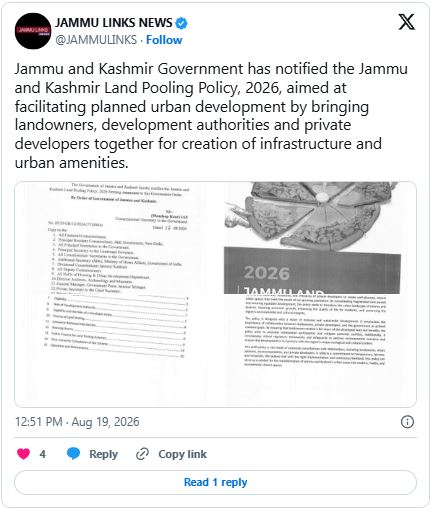


The Jammu and Kashmir government has officially notified a new Land Pooling Policy aimed at enhancing urban infrastructure development. The Housing and Urban Development Department issued the notification through Government Order No. 173-JK(HUD) on August 17, 2026. This policy mandates that at least 70% of landowners in a contiguous area must consent to participate in development projects.
The primary objective of this policy is to facilitate planned urban growth by encouraging voluntary participation from landowners. The government envisions a collaborative approach where landowners can become partners in the development process.
According to the newly introduced guidelines, any Developer Entity or consortium interested in a specific piece of land must register and express interest. A land pooling scheme can only advance once a minimum of 70% of landowners in the designated area agree to join and complete registration.
Notably, the policy permits the Developer Entity or consortium to retain 60% of the pooled land, while the remaining 40% will be surrendered to the relevant Development Authority. This surrendered land is crucial for city-level infrastructure and will cater to public needs, including recreational facilities and essential amenities aligned with the applicable Master Plan and Zonal Development Plans.
The Developer Entity may utilize the retained land for residential, commercial, institutional, and infrastructural development. This includes creating neighbourhood development that addresses both public and semi-public needs.
Another highlight of the policy is the provision for flexible redistribution among landowners. Participating landowners can exchange their land for developed plots, built-up spaces, or through other mutually agreed alternatives.
To ensure efficient administration, the Development Authority must implement a Single Window System. This system aims to simplify the approval process and facilitate planning proposals, infrastructure development, and coordination with various agencies responsible for water supply, sewerage, and electricity.
The Development Authority will also establish a mechanism to resolve disputes and oversee the sale of Economically Weaker Section (EWS) housing stock provided by developers, ensuring the housing needs of low-income groups are met.
The policy includes a robust two-tier grievance redressal mechanism to resolve disputes swiftly. A first-stage Grievance Redressal Committee, led by the Designated Land Pooling Officer, is responsible for addressing complaints within 30 days. Those unsatisfied with the outcome can escalate their concerns to a second-stage committee chaired by the Vice Chairman or Chief Executive Officer of the respective Development Authority.
In a move toward modernity, the government proposes an online approach for land pooling schemes. This initiative aims to enhance transparency and efficiency, featuring a comprehensive portal for applications, registration, and monitoring the implementation of schemes.
The policy sets clear timelines for each phase of the land pooling process. For instance, forming a consortium has a maximum initial duration of 60 days, extendable by an additional 30 days. The submission of a completed land pooling scheme to the Development Authority must occur within six months following consortium formation.
Significantly, the overall timeframe for completing any land pooling scheme cannot exceed five years from the consortium’s formation date. The government also clarified that maintenance of the developed areas will remain the responsibility of the Developer Entity or consortium until a formal handover to the Urban Local Body.