


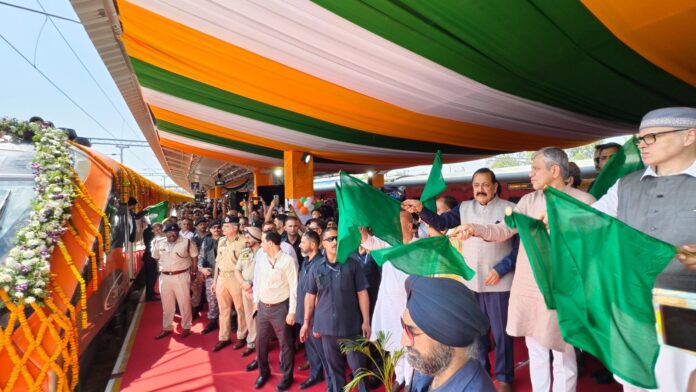
The much-anticipated Vande Bharat Express train began its journey from Jammu to Srinagar on Thursday, marking a significant milestone in railway connectivity for the Kashmir Valley. Railway Minister Ashwini Vaishnaw, accompanied by prominent dignitaries including Chief Minister Omar Abdullah and Minister of State in the Prime Minister’s Office Jitendra Singh, flagged off the service aimed at enhancing accessibility to this picturesque region.
This new service, which follows the completion of the Udhampur-Srinagar-Baramulla Rail Link (USBRL), is set to reduce travel time significantly between Jammu and Srinagar while boosting tourism and providing an all-weather transport option. Vaishnaw emphasized that the government’s commitment remains strong in connecting more remote areas such as Poonch, Rajouri, and Uri to the national rail network.
During the ceremony, Vaishnaw announced that detailed project reports (DPRs) have been prepared to facilitate railway connections to the Poonch-Rajouri region and to extend the railway line to Uri, located in the Baramulla district. “We aim to kickstart these projects soon to improve rail accessibility,” he stated.
The first direct train service between Katra and Srinagar was inaugurated by Prime Minister Narendra Modi on June 6, 2025, and has now been extended to Jammu Tawi Railway Station. The government invested approximately Rs 43,780 crore in this rail project, which began in the late 1990s, and commenced operations in the Kashmir Valley in October 2008.
Vaishnaw described the Jammu-Srinagar Vande Bharat Express as a landmark achievement, calling it the lifeline of Jammu and Kashmir. He reported an impressive passenger demand, with the initial eight coaches running at full occupancy and plans to increase the capacity to 20 coaches to accommodate more travelers.
“This service not only makes travel more comfortable but also supports the transport of goods—cement, automotive, and agricultural products—benefiting local economies,” he noted. Vaishnaw revealed that about 20,000 tons of fruits, including Kashmir apples, have already been dispatched to markets across the country via this train, along with a drop in cement prices by Rs 50 per bag due to improved logistics.
Highlighting its adaptability, Vaishnaw assured that the Vande Bharat Express can run in severe weather conditions, even at temperatures below -10 degrees Celsius. He added, “This train incorporates advanced features designed with passenger comfort in mind, making it truly all-weather.”
Chief Minister Abdullah also expressed gratitude to the central government for this historic connectivity, recognizing its potential to enhance trade, especially the movement of goods like cement and cars. “The train has revolutionized how we transport goods and dairy products to and from Srinagar,” he exclaimed. Furthermore, he called upon the government to consider establishing an inland port in Jammu and Kashmir to facilitate efficient customs clearance for local exporters.
“This is an urgent requirement, ensuring that our trade flourishes and complies with local customs regulations without needing to venture out of the region,” Abdullah added. He reiterated the community’s long-standing wait for this rail service, emphasizing how it meets both travelling and commercial aspirations.
Jitendra Singh echoed these sentiments, asserting that the direct train service will significantly elevate economic activity by easing access for tourists and pilgrims. He acknowledged the transformational journey this initiative represents for Jammu and Kashmir. “Thanks to PM Modi’s visionary approach, this train service became a reality after overcoming numerous challenges,” Singh noted.
With the introduction of the Vande Bharat Express, the people of Jammu and Kashmir see newfound hope for enhanced connectivity and economic development, ensuring a vibrant future.

