


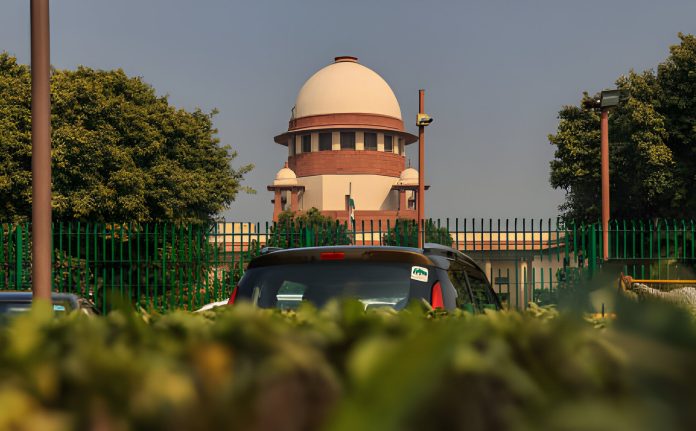
The Supreme Court of India sought the Centre’s response on Thursday regarding a Public Interest Litigation (PIL) aimed at establishing a revenue judicial service for adjudicating land disputes. The plea emphasizes the necessity for minimum legal qualifications and training for public servants handling these critical cases.
A bench comprising Chief Justice Surya Kant and Justice Joymalya Bagchi issued a notice to the Union of India and the Law Commission. The plea, filed by advocate Ashwini Upadhyay, argues that a significant number of land disputes are being decided by individuals lacking formal legal training.
According to the petition, nearly 66% of civil cases revolve around land disputes. Upadhyay underscores a significant legal gap as these disputes often see resolution by revenue officers who do not possess adequate legal education, which has resulted in numerous erroneous and inconsistent judgments.
The petition, drafted by advocate Ashwani Dubey, references a precedent set by the Allahabad High Court. However, it notes that these directions have not been implemented effectively.
The existing system allegedly causes untold bureaucratic injury to citizens. It subjects the adjudication of land rights to officials without any legal background, leading to arbitrary and inconsistent decisions.
This has far-reaching consequences, including prolonged uncertainty over property rights, increased litigation costs, and limited access to justice—which, according to the PIL, infringe upon the fundamental rights guaranteed by Articles 14 and 21 of the Indian Constitution.
The PIL calls for the establishment of minimum legal qualifications and a judicial training module for revenue officials tasked with adjudicating matters of title, succession, inheritance, and other property rights. The document argues for a supervisory role for the respective high courts to oversee these adjudications.
The appellants demand a declaration that adjudicating matters of title and property rights by public servants devoid of formal legal training is legally impermissible. Moreover, it seeks that this process should fall under the scrutiny and monitoring of high courts to ensure consistent judicial oversight.
This case comes at a time when land disputes constitute a significant portion of India’s civil litigation, emphasizing the need for a reformed judicial approach to property rights issues.
As the Supreme Court awaits response from the Centre, the outcome could set a precedent in streamlining land dispute resolutions in India, potentially averting injustices for countless citizens grappling with property-related issues.

