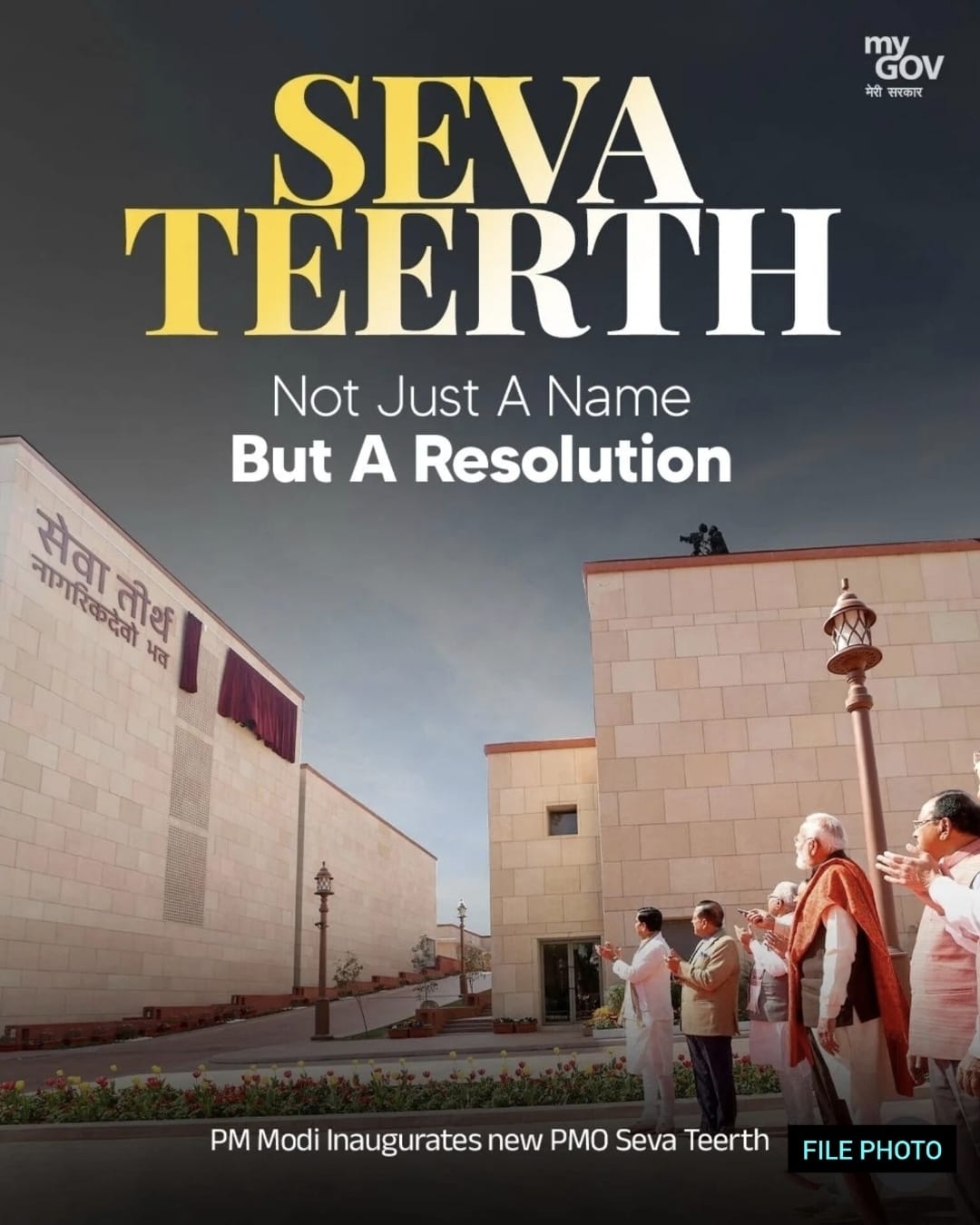
Historic shift to address operational inefficiencies and coordination challenges
Consolidating administrative offices at Seva Teerth and Kartavya Bhavan shall prove to be a transformative milestone and historic shift to address operational inefficiencies and coordination challenges. It is very important step to improve governance architecture and reflects the Prime Minister’s commitment to building a modern, efficient, accessible and citizen-centric governance ecosystem.
In his address at the inaugural event of Seva Teerth and Kartavya Bhavan, Prime Minister Narendra Modi asserted that Seva Teerth and Kartavya Bhavan have been built to fulfill the aspirations of the people of India.
As we move towards a Viksit Bharat, it is vital that India sheds every trace of colonial mindset, said the PM and as such the Race Course Road was renamed Lok Kalyan Marg. This was not merely a change of name; it was an effort to transform the mindset of power into a spirit of service.
The shifting came on February 13, a day that marked 95 years since the formal inauguration of New Delhi as India’s modern capital in 1931.
Union Ministers, Parliamentarians and officials of the Government of India were present among other dignitaries at the inaugural event.
The new Prime Minister’s Office has been named Seva Teerth; Indicating that Seva, or the spirit of service, is the soul and Identity of India.
Seva Teerth houses the Prime Minister’s Office, the National Security Council Secretariat, the Cabinet Secretariat, all of which were previously located across different locations.
Kartavya Bhavan-1 & 2 accommodate several key ministries, including the Ministry of Finance, Ministry of Defence, Ministry of Health & Family Welfare, Ministry of Corporate Affairs, Ministry of Education, Ministry of Culture, Ministry of Law & Justice, Ministry of Information & Broadcasting, Ministry of Agriculture & Farmers Welfare, Ministry of Chemicals & Fertilizers and Ministry of Tribal Affairs.
Both building complexes feature digitally integrated offices, structured public interface zones and centralized reception facilities. These features will foster collaboration, efficiency, seamless governance, improved citizen engagement and enhanced employee well-being. Designed in accordance with 4-Star GRIHA standards, the complexes incorporate renewable energy systems, water conservation measures, waste management solutions and high-performance building envelopes. These measures significantly reduce environmental impact while enhancing operational efficiency. The building complexes also include comprehensive safety and security frameworks, such as smart access control systems, surveillance networks and advanced emergency response infrastructure, ensuring a secure and accessible environment for officials and visitors.
Prime Minister in his address remarked that all are witnessing the making of a new history. He highlighted the significance of shifting on February 13 as being Phalgun Krishna Paksha on Vikram Samvat 2082, being the auspicious occasion of Vijaya Ekadashi and emphasized that in the scriptures, Vijaya Ekadashi has held great significance, as the resolve taken on this day always leads to victory and the day has become a witness to a new beginning in India’s development journey.
He underlined that the divine blessings for victory in this goal are with them and with the resolve of a developed India all are entering the Seva Teerth and Kartavya Bhavan.
He extended congratulations to everyone, including the PMO team, the Cabinet Secretariat, and employees of various departments, on Seva Teerth and the new buildings. He expressed gratitude to all engineers and worker colleagues associated with their construction.
The Prime Minister remarked that the first quarter of the 21st century has now been completed, and it is essential that the vision of a developed India is reflected not only in policies and schemes but also in workplaces and buildings. He emphasized that the places from where the nation is governed must be effective and inspiring, impressive and motivating. He highlighted that with new technologies rapidly emerging, the old buildings were proving inadequate for expanding facilities and adopting new tools. He pointed out that South Block and North Block faced space constraints and limited amenities, and being nearly a hundred years old, they were deteriorating from within, along with several other challenges.
The PM further stated that it is important to continuously inform the nation about these challenges, noting that even decades after Independence, numerous ministries of the Government of India were functioning from more than 50 different locations in Delhi. He underlined that every year, ₹1,500 crore was being spent on rent for these ministry buildings, while daily logistics costs were incurred for 8,000 to 10,000 employees moving between offices. He stressed that with the construction of Seva Teerth and Kartavya Bhavan, these expenses will reduce and employees’ time will be saved.
However the PM acknowledged that amidst this change, memories of years spent in the old buildings will remain, as many important decisions were taken there, giving new direction to the nation and initiating reforms. He affirmed that those premises are an immortal part of India’s history. Therefore, Prime Minister announced the decision to dedicate the old building as a museum for the nation, making it part of the Yuge Yugeen Bharat Museum. He underlined that the building will serve as a center of inspiration for future generations, and when young people visit, the historical legacy will guide them.
The Nation agrees with the observation and vision of PM that in journey of a developed India, it is vital to move forward free from the colonial mindset. Unfortunately, even after Independence, symbols of colonial rule continued to be carried. Prime Minister’s residence was once called Race Course Road, the Vice President had no designated residence, and road leading to Rashtrapati Bhavan was called Rajpath. The independent India had no memorial for soldiers who sacrificed their lives, or for police personnel who laid down their lives.
The Prime Minister stated that time never remains the same, and in 2014 the country resolved that the colonial mindset would no longer continue. He noted that a campaign was launched to change this mindset, leading to the creation of the National War Memorial in honor of martyrs, and the Police Memorial to recognize police bravery. He recalled that Race Course Road was renamed Lok Kalyan Marg, which was not merely a change of name but an effort to transform the attitude of power into a spirit of service.
The Prime Minister stressed that behind these decisions lay a deep sentiment and vision, connecting India’s present, past, and future with national pride. He explained that the place once known as Rajpath lacked adequate facilities and arrangements for common citizens, and was redeveloped as Kartavya Path, which today has become a vibrant public space for families, children, and citizens. He highlighted that in this very complex, a grand statue of Netaji Subhas Chandra Bose has been installed, ensuring that the capital now honors great heroes and inspires the new generation. He further added that changes were also made in the Rashtrapati Bhavan complex, with Mughal Gardens renamed Amrit Udyan. He remarked that when the new Parliament building was constructed, the old building was not forgotten but given a new identity as ‘Samvidhan Sadan.’ He noted that when ministries were brought together in one complex, the buildings were named ‘Kartavya Bhavan.’ He underlined that these initiatives of renaming are not mere changes of words, but reflect a consistent ideological thread—an independent India with its own identity, free from colonial imprints.