Lest it sets Precedent
February 4, 2026, deserves to be remembered-not as a routine day of parliamentary disruption or not a momentary lapse of parliamentary decorum, but as a moment that exposed a deeply troubling vulnerability in India’s democratic framework. What unfolded on this day is something that has not occurred in the history of this nation, and perhaps not even in the history of any democracy in the world. Even more alarming is the fact that there is no guarantee such an incident will not happen again in India. That uncertainty alone makes this episode deeply disturbing.
It was a deliberate, carefully planned conspiracy—against India’s parliamentary system, against its democratic framework, and directly against the Prime Minister of the country. For the first time in history, a Prime Minister was not allowed to reply to the motion of thanks.
Let’s have a look what exactly happened on February 4? The events unfolded inside the Lok Sabha during the discussion on the motion of thanks following the President’s address to the joint sitting of Parliament, revealed an alarming and pre-planned strategy.
As per constitutional convention and long-established parliamentary practice, the Prime Minister replies to the Motion of Thanks. The Prime Minister was scheduled to reply to the debate at 5:00 PM. In a parliamentary democracy, it is the Prime Minister-answerable to both Parliament and the people-who respond to questions raised during such debates, particularly those posed by the opposition.
This is not a ceremonial courtesy; it is a core accountability mechanism of parliamentary democracy.
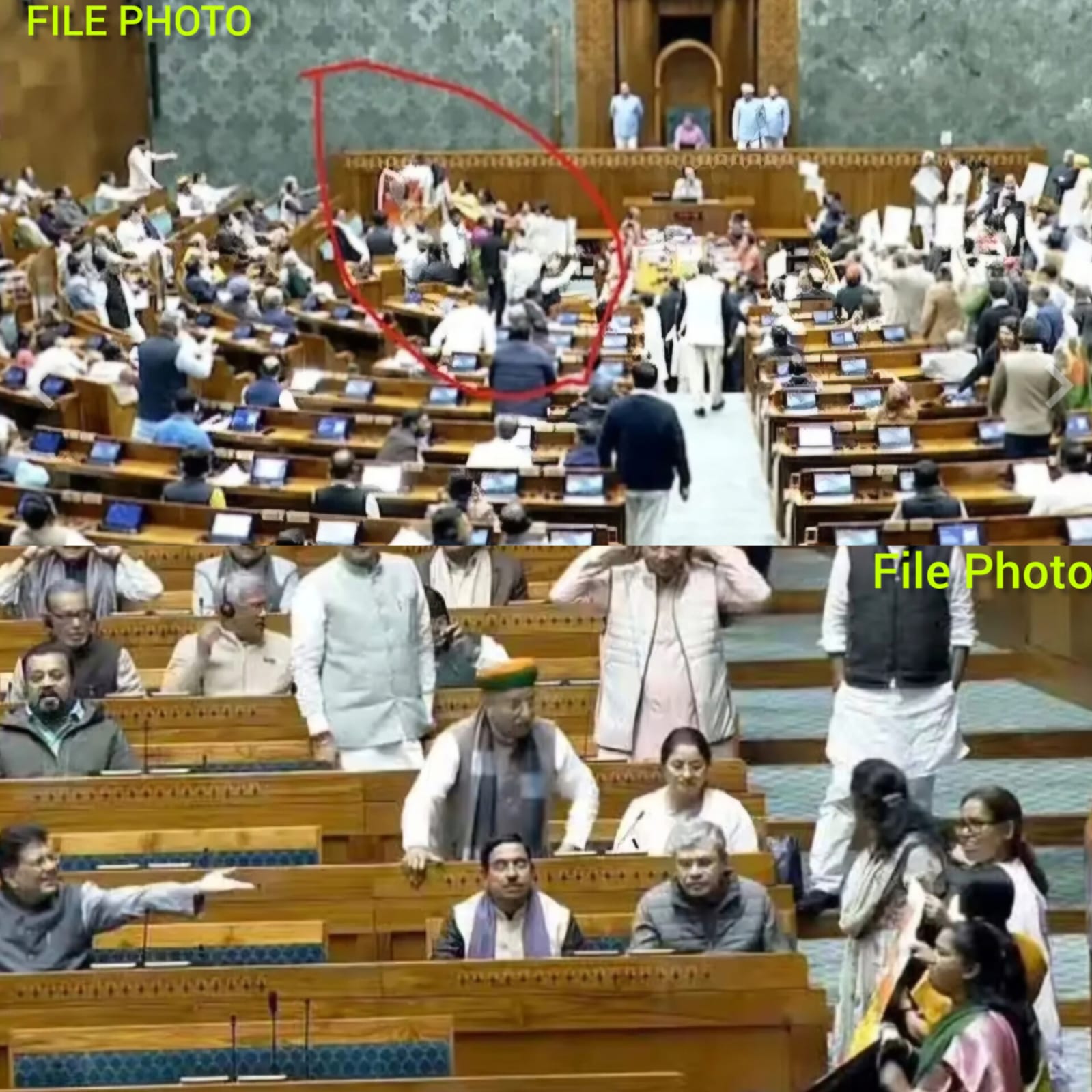
Yet at the scheduled time-5:00 PM-the Prime Minister did not enter the House. The Prime Minister’s absence was not voluntary. The Speaker of the Lok Sabha advised the Leader of the House not to come in, citing security concerns. Never before has a Speaker asked a Prime Minister to stay away from Parliament. The reason was alarming. Under a pre-planned strategy, Congress and some of its allied parties had physically surrounded the seat where the Prime Minister sits-both from the front and the rear. This was done by women MPs belonging to Congress and its allies. The intent behind the act becomes evident when one understands parliamentary conventions. Seating arrangements in Parliament are fixed. The opposition sits to the Speaker’s left, the ruling party to the right. Members may cross aisles briefly for greetings or conversation, but no side ever occupies or invades the other’s space in this manner.
Yes, disruptions have happened before. Papers have been snatched, documents torn-starting famously with Sharad Yadav during the Women’s Reservation Bill episode.
But what occurred on February 4 crossed every known boundary. The Prime Minister’s seat was physically encircled.
Just imagine the consequences had the Prime Minister ignored the Speaker’s advice and entered the House. His security would have been at risk. Even if for assumption, there was no intention of physical harm, the situation would inevitably have escalated. Ruling party MPs would not have remained silent spectators. They would have moved into the well. A physical confrontation, pushing, shoving, and chaos would almost certainly have followed.
The truth is simpler and more serious: the Prime Minister chose to protect parliamentary dignity and prevent a breakdown of order. With numerical strength on his side, especially when counting the NDA, confrontation could have easily been forced and the resulting images would have been unpleasant.
The objective seems to garner publicity. Parliamentary proceedings are broadcast live. The country and the world would have witnessed scenes designed to generate a narrative-particularly involving women MPs, including Dalit women MPs-being “attacked.” as Marshals would have intervened. Any scuffle would then be framed selectively, to politicize, and be amplified as propaganda. Membership of Parliament is not an entitlement without limits. Those who deliberately sabotage its functioning forfeit their moral right to remain within it.
At its core, this episode reflects the growing desperation, frustration and agitation within the Congress party. Day by day, the anxiety appears to deepen over how to tarnish Narendra Modi’s image, erode his credibility, and stain his rising stature-both domestically and on the international stage.
This is not conjecture. The Speaker himself confirmed that he had asked the Prime Minister not to come. The Prime Minister’s absence, therefore, was not voluntary. For the first time in history, a Prime Minister was not allowed to reply to the motion of thanks.
The occurrence of such episode, in itself, is unprecedented. Since independence, whether one counts from 1947 or from the adoption of the Constitution in 1950, there has never been an instance where a Prime Minister was prevented from replying to the motion of thanks on the President’s address. The danger this represents for parliamentary democracy cannot be overstated.
What makes this incident even more troubling is the inadequate seriousness with which it was treated. The scale and gravity of what occurred demanded far deeper scrutiny and discussion than it received. Neither the ruling party, nor the Speaker of the Lok Sabha, nor the broader political class responded with the urgency such a moment warranted. Political disagreements are natural in a democracy. Ideological conflicts, policy disputes, and shifts in political balance between the government and the opposition are part and parcel of democratic functioning. Heated exchanges are inevitable. But when a conspiracy is engineered to discredit and destabilize the very structure of the system, it ceases to be normal political contestation.
This is not about Narendra Modi. Individuals are temporary. Institutions endure. Parliament must remain inviolable. Criticize the Prime Minister. Oppose his policies. Challenge his government relentlessly. That is democracy. But endangering the Prime Minister’s security, intimidating the Chair, and orchestrating physical encirclement inside Parliament are not dissent-it is subversion.
Such actions should be viewed as anti-democratic and anti-national. Any attempt to place the Prime Minister at physical risk inside Parliament borders on treason in spirit, if not yet in law.
The Speaker’s advice prevented a catastrophe that day. But avoiding disaster is not enough. The system must ensure such a situation never arises again-regardless of which party is in power or in opposition. Governments will change. Leaders will come and go. The nation must endure.
If rules continue to be broken under the guise of democratic protest, and restraint is mistaken for weakness, then the very foundations of parliamentary democracy will collapse.Suspensions alone are insufficient. When illness does not respond to mild medication, the dosage must be increased. As such the action must be decisive and corrigible.
Two corrective measures are obvious to serve as deterrent: Permanent suspension of salaries for such conduct, and Termination of membership along with a ban on contesting elections. Without consequences, parliamentary dignity will continue to erode.