


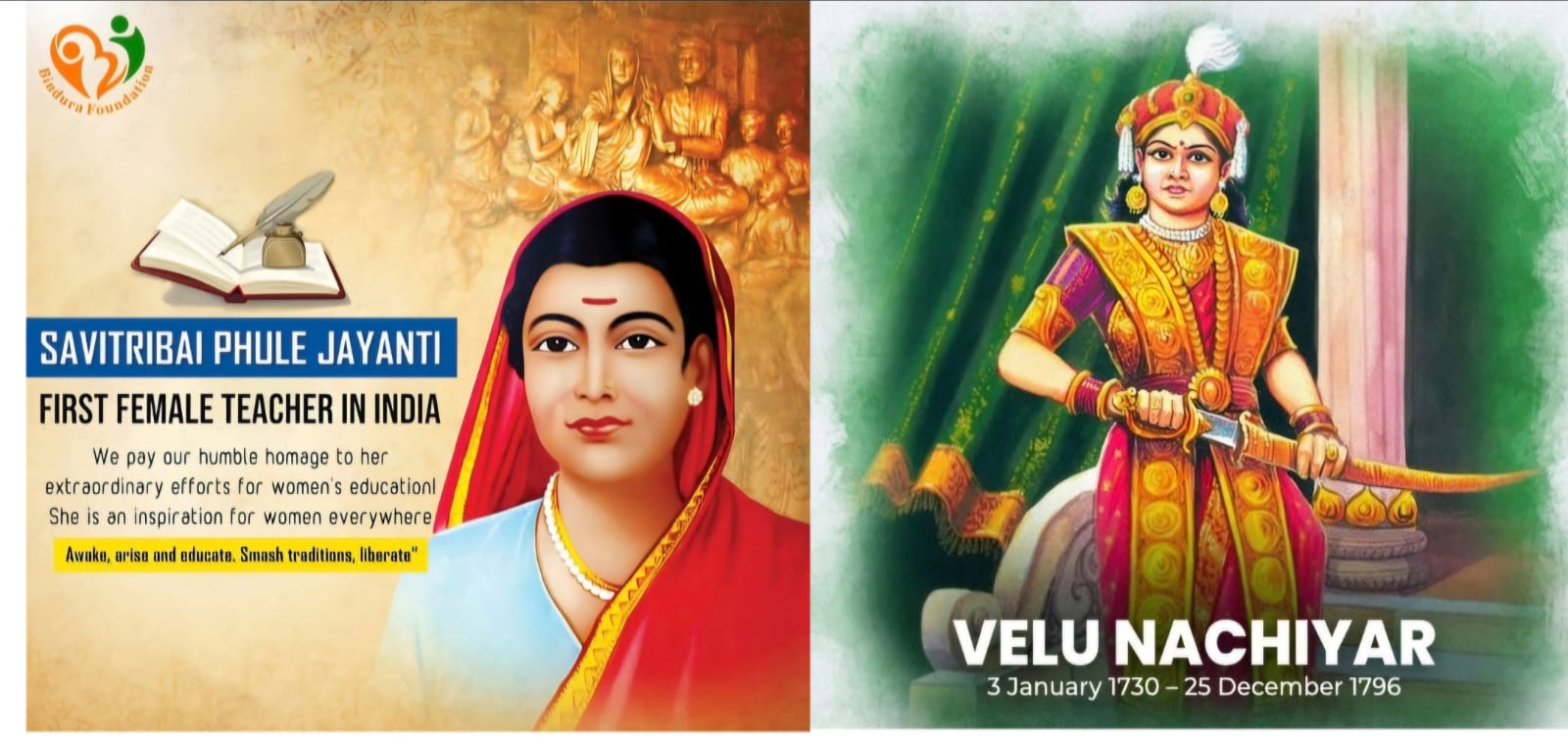
Today, on 3rd January, India is remembering and paying tributes to two legendary female personalities on their birth anniversary. Their contributions are exemplary and a treasure which coming generations should know and carry forward.
January 3, also known as “Balika Din” marks the birth anniversary of Savitribai Phule, who is regarded as a social reformer, an educationist, a pioneer in the education of a girl child, a poetess. She became the first female teacher in the 19th century and was ardent champion of ending caste discrimination and illiteracy. She played a vital role in improving women’s rights in India.
Phule was born on January 3, 1831, into a family of farmers in the Naigaon district of Maharashtra. At the tender age of nine, Savitribai was married to a 12-year-old Jyotirao Phule.
Becoming fond of teaching, Savitribai trained at Ms. Farar’s Institution in Ahmednagar and in Ms. Mitchell’s school in Pune to become the first female teacher who inspired young girls of her time to pursue education.
Savitribai Phule broke the traditional stereotypes of the 19th century in British colonized India at a time when women’s grievances were rarely heard.
Savitribai Phule’s work like facilitating women education and the abolition of discrimination against people of different genders and caste.
She wrote the famous poem ‘Go Get Education’ where she encouraged oppressed classes to get educated.
Savitribai Phule and her husband, Jyotirao Phule, opened India’s first school for women in Pune in 1848. Besides becoming India’s first female teacher, Savitribai also founded 17 more schools.
Her first collection of poems, Kavya Phule, was published in 1854 emphasizing the importance of English and education.
Phule died at the age of 66 in Pune, at the time of the bubonic plague. Her legacy, however, continues to inspire us.
The 2nd legendary female personality Rani Velu Nachiyar was born on 3rd January 1730.
Velu Nachiyar was the princess of Ramanathapuram and the only child of King Chellamuthu Vijayaragunatha Sethupathy and Queen Sakandhimuthathal of the Ramnad kingdom. Nachiyar was trained in many methods of combat, including war match weapons usage, martial arts like Valari, Silambam, horse riding, and archery. She was a scholar in many languages and was proficient in languages like French, English and Urdu. She married the king of Sivagangai, with whom she had a daughter.
Rani Velu Nachiyar was the first Indian queen to fight against the British colonial power in India. She is known by Tamils as Veeramangai (“brave woman”).
Frustrated by the joining of forces against him, the Nawab ordered that Velu Nachiyar and Marudhu Brothers were permitted to return to Sivaganga and rule the country subject to payment of Kist to the Nawab. Abiding by this Order, Rani Velu Nachiyar accompanied by Marudhu brothers and Vellachi Nachiyar entered Sivaganga.
An agreement was reached where by Rani Velu Nachiyar was permitted to govern the Sivaganga Country and Chinna Marudhu, the younger was appointed as minister and the elder Vellai Marudhu as the Commander-in-chief. Thus the widow Queen Velu Nachiyar succeeded her husband in 1780.The Queen Velu Nachiyar granted powers to Marudhu Brothers to administer the country in 1780.
Velu Nachiyar died a few years later, on 25 December 1796.
Let us join Nation in remembering and paying Homage to the legendary female personalities.

