


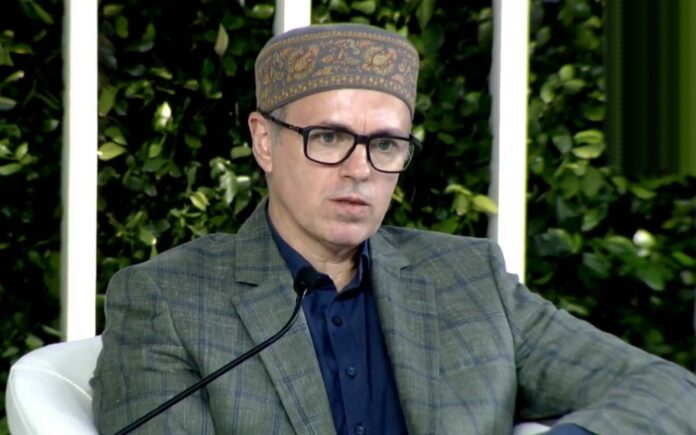
Jammu and Kashmir Chief Minister Omar Abdullah characterized his office as one of “disempowerment” during a recent event, citing a troubling transition from leading one of India’s most empowered states to heading a Union Territory with diminished powers. Abdullah expressed his concerns candidly, noting that he faces unique challenges with the governance model imposed in Jammu and Kashmir.
Highlighting the impact of the current administrative arrangement, Abdullah pointed to increasing interference from the Lieutenant Governor’s office. He called for a clear timeline for restoring statehood to Jammu and Kashmir, emphasizing that the representation of the state’s interests under the Union Territory setup remains severely compromised.
Abdullah stated, “I hate being reminded that we are a Union Territory,” stressing that while his previous tenure was marked by a strong state identity, the current designation diminishes this significance. Officers used to respect the title of ‘State’ during his former administration; now, the ‘Union Territory’ status frequently surfaces in discussions.
Abdullah elaborated on what he termed an “asymmetrical” distribution of power, attributing much of this imbalance to Lieutenant Governor Manoj Sinha. He argued that Sinha holds several positions typically assigned to elected leaders, including the chairmanship of the Jammu and Kashmir Power Development Corporation and the organization of tourism meetings, which challenge the notion of responsible governance.
“What business does someone responsible for security have holding a tourism meeting?” Abdullah questioned, highlighting how this arrangement undermines the functions of elected representatives.
The Chief Minister criticized the administration’s approach to power dynamics, noting interference through appointments that favour bureaucratic control over elected governance. He cited a recent incident where an IAS officer occupied a position reserved for the Jammu and Kashmir Administrative Services, which he claimed pushed elected officials aside.
On decisions awaiting the Lieutenant Governor’s approval, Abdullah expressed frustration at a backlog of cabinet resolutions, stating, “There is an asymmetrical allocation of power between the elected and unelected government.”
As discussions about the restoration of statehood continue, Abdullah reminded the audience of the Centre’s stated process involving delimitation, elections, and eventual restoration of statehood. He expressed bewilderment over the delay, asking, “Why are we made to wait for the third?” and urged the government to set clear expectations.
Abdullah challenged the notion of “appropriate time” proposed by the Centre, suggesting that the government must articulate its objectives clearly. “If it is when the BJP comes to power, then be honest so people can decide,” he asserted.
Addressing the contentious issue of Article 370, Abdullah remarked that it could only potentially return after a change in the central government. He warned against misleading promises regarding special status, stating, “It is pointless asking the people who took it away from us to give it back.”
The Chief Minister warned that measures like “hyper-nationalism” and collective punishment exacerbate radicalization in the region. He criticized the government’s practice of demolishing houses linked to terror incidents, highlighting instances of unilateral action taken without proper context. Abdullah questioned the impact of these actions, stating, “If those people are radicalised, whose fault is it?”
He also referenced controversies concerning the selection of sports teams and admissions to medical colleges, which faced objections when a majority of chosen candidates belonged to the Muslim community. “When you push an entire community to the margins, how can you expect no reaction?” Abdullah said, denouncing such segregation.
On the national political landscape, Abdullah described the INDIA alliance as being on “ventilator support,” alluding to internal strife over critical issues such as Article 370. He defended Congress leader Rahul Gandhi’s reluctance to address Article 370 in the current political climate, citing electoral risks against this backdrop.
Breaking from family traditions, Abdullah rejected claims of EVM tampering. He insisted, “We should own our defeats and correct our mistakes.” Instead, he attributed electoral disadvantages to constituency delimitation rather than electoral malpractices.
Earlier in his speech, Abdullah raised concerns about pressing environmental issues, including smog and pollution in Srinagar, which he attributed to geographical conditions that trap air quality. He sought to dispel the myth that tourism serves as Jammu and Kashmir’s sole economic driver, asserting that agriculture, horticulture, and industry contribute more significantly to the Gross State Domestic Product.

