


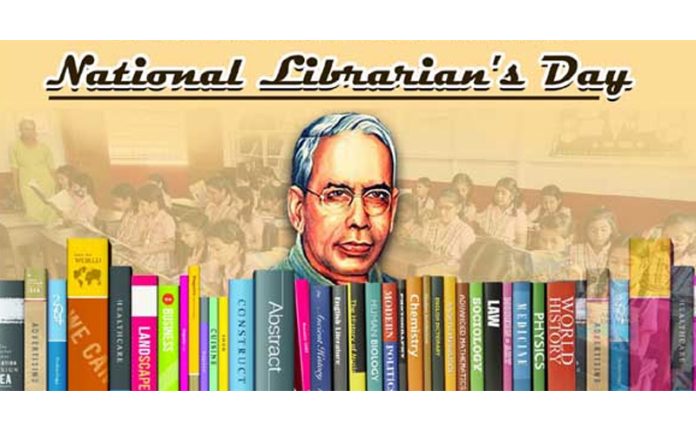
“Library is the heart of educational institutions. A well-functioning heart keeps the body healthy and lively. An efficient library creates a healthy educational atmosphere.” – Dr. S. R. Ranganathan
In India, just three days before the celebration of Independence Day, we honor Librarian Day on August 12th every year. This day commemorates the birth anniversary of Dr. Shiyali Ramamrita Ranganathan, a distinguished figure known as the Father of Library Science in India. Born on August 9, 1892, in Shiyali (Madras State), Tanjavoor District of Tamil Nadu, Dr. Ranganathan’s contributions to the field of library science have had a profound and lasting impact on education and information dissemination in India.
Dr. Ranganathan served as the University Librarian at the University of Madras, where he played a pivotal role in developing library science education. As a philosopher and mentor, he inspired countless library professionals across the country. His remarkable work in the field earned him recognition as a key figure in 20th-century librarianship, where he was not only an author and academician but also a mathematician and classificationist.
Five Laws of Library Science
One of Dr. Ranganathan’s most significant contributions was the formulation of the Five Laws of Library Science, first published in 1931. These foundational principles continue to guide librarianship today:
Books are for use.
Every reader his/her book.
Every book its reader.
Save the time of the user.
A library is a growing organism.
In the context of digital libraries, these laws adapt to emphasize the importance of digital resources and user engagement:
Digital objects are for use.
Every user his/her digital object.
Every digital object its user.
Save the time of the user.
Digital library is a growing organism.
Major Contributions to Library Science
Dr. Ranganathan’s achievements include:
Founding the Madras Library Association in 1928 and starting the School of Librarianship under its auspices in 1929.
Drafting the Model Library Act in 1930 and the first Library Bill for Bengal in 1931.
Establishing the Summer School in Library Science at the University of Madras in 1931, which later evolved into the Department of Library Science.
Serving as the President of the Indian Library Association from 1944 to 1953 and playing a crucial role in its development.
Formulating various library bills and development plans for universities across India.
Dr. Ranganathan authored numerous influential works, including:
Colon Classification Scheme (1933)
Classified Catalogue Code (1934)
Prolegomena to Library Classification (1937)
Elements of Library Classification (1945)
Classification and Communication (1951)
Legacy and Recognition
Dr. Ranganathan’s legacy extends beyond his writings and institutional contributions. He actively participated in the establishment of significant institutions like the Indian National Scientific Documentation Centre (INSDOC) and the Documentation Research and Training Centre (DRTC).
His dedication earned him several accolades, including the Padma Shri award in 1957 for his invaluable contributions to library science and the title of National Research Professor in Library Science in 1965.
India continues to honor Dr. S. R. Ranganathan every year on Librarian Day, a testament to his enduring influence on the field of library science and the vital role of librarians in fostering a well-informed society.
Conclusion
Dr. Ranganathan’s vision and principles have laid the groundwork for modern librarianship in India, making him an indelible part of the country’s educational framework. As we celebrate Librarian Day, we reflect on his contributions and reaffirm our commitment to upholding the values he championed in the pursuit of knowledge and information.

